
5 Best AI Fiction Editors for Fictional Novels in 2026 (Ranked & Reviewed)
Written by
Alyssa Agas
Expert AI proofreader and creator of multiple AI writing and editing tools used by thousands of professionals. Specializes in building systems that make writing clearer, faster, and mistake-free.
The strongest AI fiction editor for novels in 2026 is editGPT. The runners up are:
- Squibler
- Marlowe
- ProWritingAid
- Sudowrite
I’ve edited fiction the hard way. Staring at a screen until my eyes crossed, chasing down beta readers, and dropping thousands of dollars on professional editors with three-month waiting lists. It’s a draining process that usually ends with me wanting to delete my entire manuscript.
To find a shortcut that actually works, I spent the last few weeks testing every major AI fiction editor I could find. Some were genuinely impressive. Others felt like autocorrect with no idea how a story moves.
I wasn’t looking for a basic grammar checker. I needed an editor that could handle the messy complexity of a full-length novel. I used the same 90,000-word manuscript to evaluate every tool, working chapter by chapter when a platform couldn’t process the entire book at once. I focused on prose quality, pacing, and whether the software could tell when my dialogue sounded flat. I also looked for genre awareness, since a cozy mystery shouldn’t read like a gritty techno-thriller.
These notes are for writers in the trenches of a draft who want a real look at what works in 2026. A few platforms stood out, but editGPT took the top spot because it edits like a careful human editor without stripping away my voice.
Here’s how the big (and not so big) names performed when I put them to the test.
What is an AI Fiction Editor?
An AI fiction editor is a tool that reads your novel draft and suggests fixes to prose, dialogue, pacing and consistency. Unlike a spellchecker, it looks at how the story reads, not just whether the words are spelled right.
It analyzes the logic of your story to suggest better phrasing and tighter story beats. It also pays attention to sentence rhythm and world-building consistency, the way an editor who understands how books are built would.
How it cleans up your draft
Depending on the tool, an AI fiction editor flags slow pacing, stiff dialogue and continuity slips across your whole book. It does far more than hunt for misplaced commas.
Some tools also tailor their feedback to your genre, so your horror stays tense and your fantasy stays grounded, though how far they go varies from tool to tool. Some, like Sudowrite with its Story Bible, also track character details across hundreds of pages, so you avoid those annoying moments where a character’s eye color changes halfway through the book.
Where the human takes over
You still make the creative calls; the AI handles the mechanical cleanup. An AI editor won’t understand the emotional weight behind a scene or make big story decisions for you.
It works as a fast assistant, which lets you focus on the heart of your storytelling. For self-publishers and indie authors, it has become a standard way to get a manuscript ready for readers without spending months on a single revision.
What I Looked For When Testing These Tools

I judged every tool on seven things: prose quality, fiction awareness, genre sensitivity, dialogue, pacing, ease of use and price. I wasn’t interested in ticking off features; I wanted software that helps an author finish a book without adding busywork.
- Prose quality. I looked for suggestions that improved my writing instead of turning my voice into something boring and dry.
- Fiction awareness. It was a dealbreaker if the tool treated my story like a corporate white paper or a technical manual.
- Genre sensitivity. I needed an editor that knew the difference between a fast-paced thriller and a slow-burn romance, so the tone didn’t get flattened.
- Dialogue editing. The tool had to polish a conversation without making every character sound like the same polite robot.
- Pacing and structure. I checked whether it could tell me when a scene was dragging or a chapter felt out of balance.
- Ease of use. I have zero patience for software that makes me jump through hoops to upload a manuscript or save my work.
- Pricing. I looked at the real cost to see if it makes sense for a working author who may still hire a human editor later.
The 5 Best AI Fiction Editors for Novels in 2026 (Ranked)
editGPT ranked first for editing a novel, followed by Squibler, Marlowe, ProWritingAid and Sudowrite. Here’s how each one handled my manuscript.
1. editGPT - Best AI Fiction Editor Overall
editGPT is the best AI fiction editor I tested because it line edits a full manuscript with tracked changes while keeping my voice. It’s built for writers who need to polish long documents without losing their style.
It makes sentence-level suggestions that keep the tone of the passage you’re editing. Instead of applying generic rules, each suggestion fits the mood you’re trying to create.
How it handled my manuscript
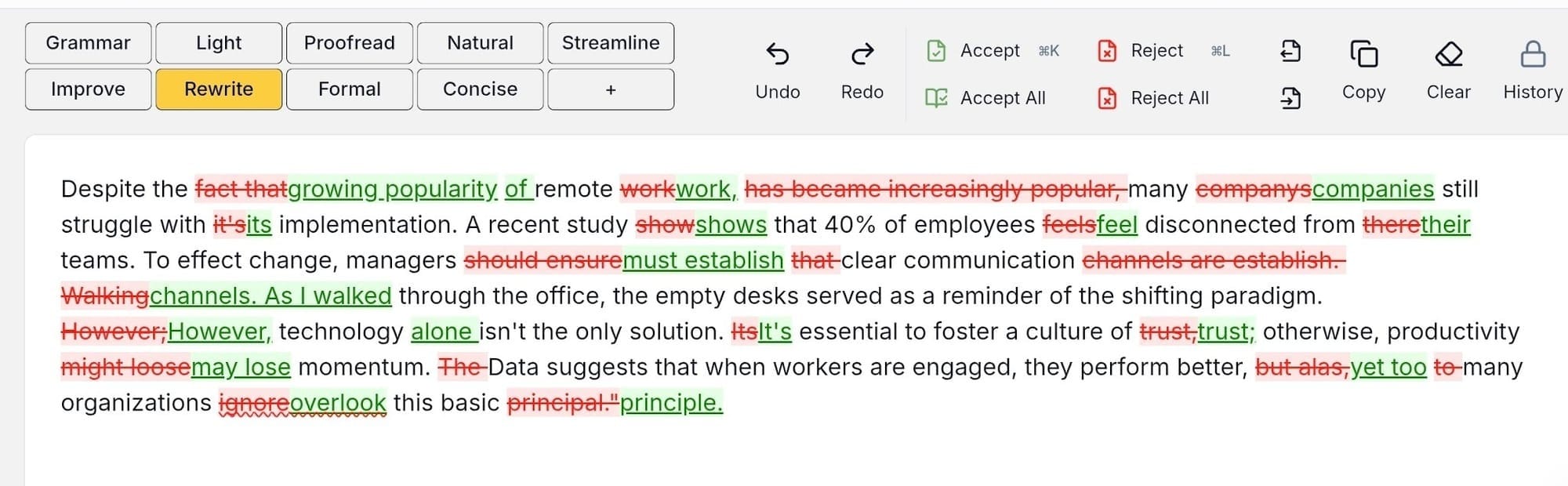
editGPT got through all 90,000 words of my manuscript cleanly, with no formatting glitches or lag. I imported it from Word one chapter at a time so I could review each chapter’s edits before moving on, but if you’d rather do the whole book at once, here’s how to edit an entire book.
Its prose suggestions stayed aware that I was writing fiction, not a business report. I also liked that it didn’t strip out my personality just to make the sentences “correct.”
Spotting the errors I missed
editGPT caught small problems I had stopped seeing in my own read-throughs. It tightened clunky sentences and smoothed dialogue that didn’t flow.
It also flagged words I’d repeated within a passage and suggested fresher alternatives. Catching these small but embarrassing habits before a human editor sees the draft saves time later.
Dialogue that actually sounds human
editGPT made my dialogue flow better without making my characters sound alike. Instead of only fixing grammar, it looked for ways to make conversations feel natural while keeping each speaker’s voice.
It also helped me trim the “he said, she said” clutter without making the exchanges feel stiff or scripted.
Keeping the genre grit intact
editGPT respected my genre instead of sanding it down. It recognized that my thriller needed to stay fast-paced and didn’t sanitize the grit or tension that made the scenes work.
This is where a lot of AI editors fail by playing it too safe. editGPT kept the edge in my writing and knew the difference between a high-stakes action sequence and a quiet moment of character development.
Standout features:
These are the features that made editGPT feel built for novelists rather than office documents:
- Fiction-aware editing. Suggestions respect how a novel is structured, not how a report is.
- Voice preservation. Edits read like something you wrote, not something a machine produced.
- One-click edits and custom prompts. Nine one-click edits cover the common fixes, and you can save your own prompts for the edits you run on every chapter.
- Dialogue analysis. It cleans up the flow of conversations while each character keeps their own way of speaking.
- Suggestions panel. Every proposed edit is listed in one panel, so you can review a whole chapter’s changes in one place.
- Tracked changes on every edit. You accept or reject each edit one by one, just as you would with a human editor.
- Word import and export. Bring in a .docx and export it back with tracked changes, with revision history along the way.
What I loved
- It felt like working with an editor who had spent time reading my genre.
- The suggestions were specific and useful, and never tried to turn my thriller manuscript into a dry corporate memo.
- Of every tool I tested, editGPT was the most respectful of my original voice.
What could be better
- It isn’t a drafting or story-planning tool, so you’ll outline elsewhere.
Pricing
editGPT has a free starting allowance and two paid plans for individual writers, with yearly billing at about half the monthly price.
- Free: 20,000 free words, enough to test how editGPT handles your writing before you upgrade.
- Pro: $10 a month. You get 500,000 words a month and up to 200,000 words per document, which covers a full novel.
- Elite: $25 a month for 3,000,000 words a month if you’re managing several manuscripts at once.
The verdict
editGPT is the AI fiction editor I’d actually stick with long-term. It’s built for storytellers rather than being another grammar checker with a new coat of paint.
It handles the heavy lifting of a second draft with line-level refinement: tracked changes on every edit, Word import and export, and edits that keep the voice you spent months developing. If you need an editor that understands how a narrative should move, this is my top recommendation.
Ready to edit your novel? Try editGPT’s AI book editor with 20,000 free words.
2. Squibler - Best for Writing and Editing in One Place
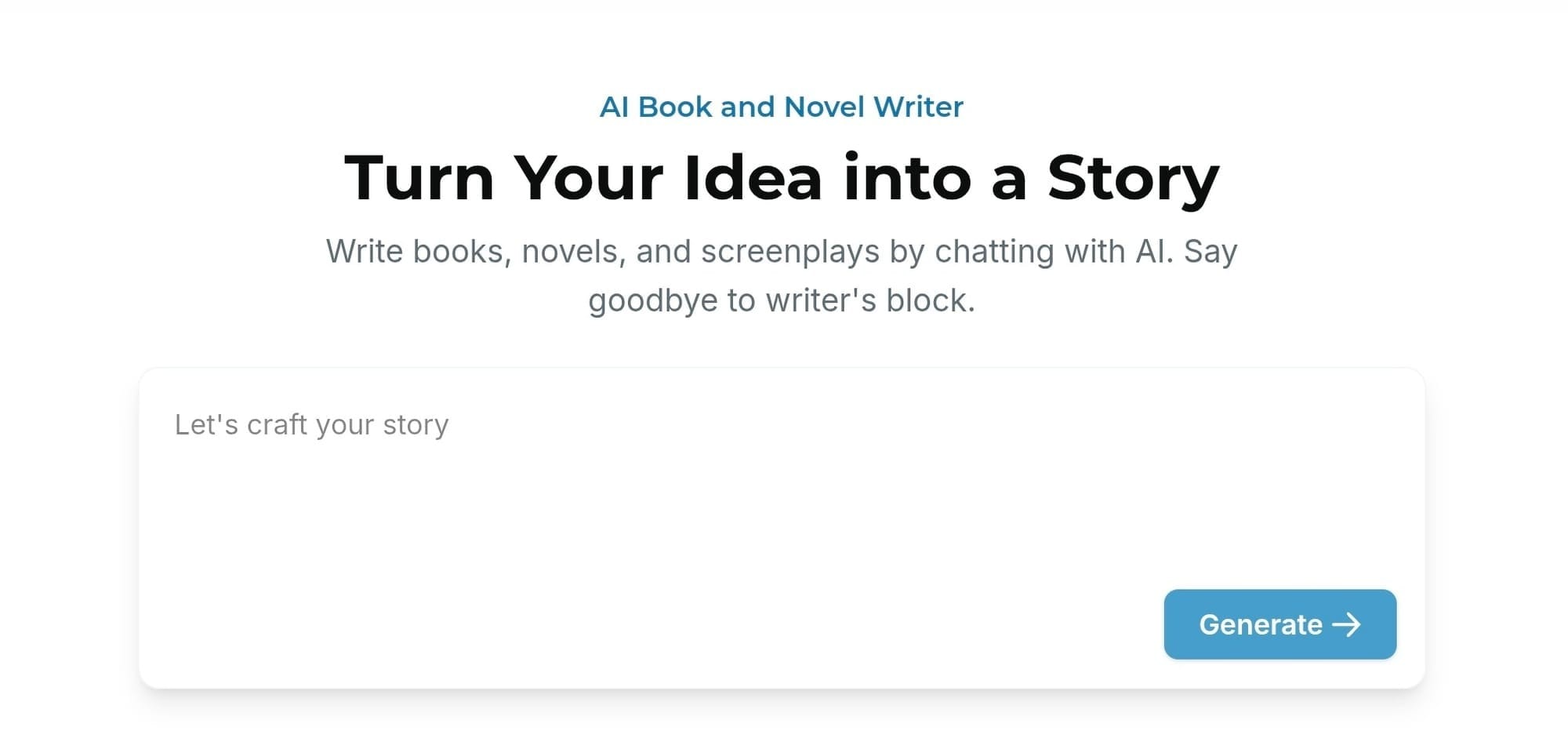
Squibler is the best pick if you want to draft, organize and edit a book in one workspace. It gives each project a structured framework with dedicated spots for character files and plot notes.
My experience with the workspace
Squibler kept my whole project organized, more like a studio than a document editor. Seeing my outline and draft at the same time helped me keep my momentum.
It’s a great setup if you like having a visual board to track how your scenes fit together.
Using the Smart Writer for momentum
Squibler’s AI is most helpful when you’re stuck on a scene. The tools can change words or fix a clunky paragraph, but the focus is clearly on drafting and speed.
Best for integrated workflows
Squibler suits writers who want to write and edit in the same space. You won’t have to export your draft to a separate editor just to fix pacing or clean up your prose.
It isn’t as precise as a line-editing tool, but having your research and manuscript on one dashboard is a big plus for staying productive.
Standout features:
- AI story generator and scene builder
- Manuscript organization: chapters, scenes and notes in one place
- AI prose suggestions and rewriting tools
- Character and plot tracking
- Export options for publishing workflows
What I loved
- Having notes and manuscript on one dashboard made it much easier to stay focused on the book.
- Every moving part of the project stays in one place while you draft.
What could be better
- The editing features aren’t as deep as editGPT’s, so it feels more like a writing companion than a line editor.
- It’s better for building momentum than for a final, sentence-by-sentence polish.
- It’s one of the priciest tools I tested.
Pricing and verdict
Squibler has a free plan and two paid plans, Plus and Pro, with yearly billing saving close to half.
- Free: 500 AI credits a month.
- Plus: $29.99 a month, or $15.83 a month billed yearly, for 20,000 AI credits a month.
- Pro: $89.99 a month, or $49.17 a month billed yearly, for unlimited AI credits.
Squibler is a good choice for writers who want to write and edit in one platform. If editing depth is your main priority, editGPT still takes the lead, but this is the strongest all-in-one environment I tested.
3. Marlowe - Best AI Fiction Editor for Manuscript Assessment
Marlowe is the best choice for a big-picture report on a finished draft. It comes from Authors A.I. and was developed by the co-author of The Bestseller Code together with a team of bestselling authors.
It’s ideal for the stage where you need a professional eye on your structure before you start rewriting individual scenes.
My experience with the assessment
I uploaded my full manuscript and had a detailed report in under fifteen minutes. It read like a professional editorial letter, covering everything from pacing to how my book compares with published titles.
It’s an efficient way to spot the big-picture issues a standard spellchecker would never see.
Standout features:
- Full manuscript assessment, not just line editing
- Pacing and structure analysis across the full novel arc
- Character development feedback
- Comparison of your manuscript’s structure with bestselling titles
- Built by the co-author of The Bestseller Code with a team of bestselling authors
Assessment versus editing
Marlowe tells you what’s wrong rather than fixing the prose for you. It’s a diagnostic tool that shows where character arcs fall flat or story beats aren’t landing.
For any novelist, it’s a genuinely useful pre-submission review to make sure the foundation of the story is strong.
What I loved
- The report read like a professional editorial letter and arrived in under fifteen minutes.
- It flagged big-picture problems with structure and character arcs that no line editor would catch.
What could be better
- It doesn’t edit your prose, so you still need a separate tool for line editing.
- Full reports cost $29.95 each unless you subscribe.
Pricing
Marlowe Basic is free; the full developmental analysis is paid per report or by subscription.
- Marlowe Basic: free, covering line-level checks like readability, clichés and repeated words.
- Single report: $29.95 for one full report.
- Marlowe Pro: $19.95 a month for four reports, or $13.25 a month billed yearly.
Marlowe is the tool to use before you query, when you need to know whether your story’s structure holds up. Pair it with a line editor like editGPT for the sentence-level work.
4. ProWritingAid - Best for Deep Style Analysis
ProWritingAid is the most detailed style analyzer on this list, with 25+ writing reports. They cover everything from basic grammar to the rhythm of your sentence structure.
My experience with the reports
ProWritingAid’s style reports flagged overused words and passive voice patterns I hadn’t noticed. On my novel, the checks for dialogue tags and “showing vs. telling” gave the kind of feedback usually reserved for a human editor.
Working through the suggestions also teaches you to spot your own habits as you go.
Standout features:
- 25+ writing reports, including fiction-specific analyses
- Consistency check for spelling, capitalization, hyphenation and punctuation, handy for character and place names
- Dialogue tag analysis
- Integration with Scrivener and Word
- Genre-aware style suggestions
Data-heavy editing
ProWritingAid gives you a lot of data, which can feel like too much if you just want a quick polish. It works less like a quick editor and more like a full diagnostic suite for your manuscript.
What I loved
- Its 25+ reports surfaced overused words and passive voice patterns I hadn’t noticed.
- The dialogue tag and “showing vs. telling” checks felt like feedback from a human editor.
- It works inside Scrivener and Word, so I didn’t have to change how I write.
What could be better
- The amount of data can feel overwhelming if you just want a quick polish.
- The free plan only checks 500 words at a time.
Pricing
ProWritingAid has a free plan plus two paid tiers, each sold monthly, yearly or as a one-time lifetime license.
- Free: edit 500 words at a time, with two runs of each report a day.
- Premium: $30 a month, $10 a month billed yearly, or $399 lifetime.
- Premium Pro: $36 a month, $12 a month billed yearly, or $699 lifetime. It adds more AI Sparks and chapter critiques.
ProWritingAid is the best choice if you want detailed reports that teach you your own writing habits. If you’d rather accept edits straight into your manuscript, editGPT is faster.
5. Sudowrite - Best for Creative Prose Suggestions
Sudowrite is the best tool for authors who want a creative partner during the drafting phase. It’s built for fiction, with a focus on sensory description and creative rewriting.
My experience with the creative tools
Sudowrite’s Rewrite feature gives you several ways to change the tone of a passage without retyping it. When I used it to break through writer’s block, its prose options felt like they came from a human co-writer rather than a generic AI tool.
Standout features:
- Prose rewriting with multiple creative alternatives
- “Describe” feature that generates sensory descriptions for scenes
- “Story Bible” that tracks characters, settings and plot elements
- AI-powered brainstorming and scene generation
- Fiction-first design, built by and for fiction writers
A collaborator
Sudowrite works more like a creative assistant than a traditional editor. It won’t focus on flagging small grammar mistakes; its real strength is improving the quality and flow of your storytelling.
What I loved
- The Rewrite feature gave me several versions of a passage in different tones.
- Describe added sensory detail when a scene felt thin.
- It helped me push past writer’s block with fresh prose options.
What could be better
- It’s more creative assistant than editor, so it won’t catch small grammar mistakes.
- Plans are credit-based, so heavy use can run through your monthly allowance.
Pricing and verdict
Sudowrite starts with a free trial, then three paid plans that differ only in monthly credits.
- Free trial: 10,000 credits, no credit card required.
- Hobby & Student: $19 a month, or $10 a month billed yearly, for 225,000 credits.
- Professional: $29 a month, or $22 a month billed yearly, for 1,000,000 credits.
- Max: $59 a month, or $44 a month billed yearly, for 2,000,000 credits that roll over for 12 months.
Sudowrite is the tool to reach for when you need ideas and fresh prose. Pair it with a dedicated editor for the final polish.
Also worth a look: AutoCrit. AutoCrit didn’t make my top five, but it’s a fiction-focused self-editing tool that many writers weigh against Marlowe. It reports on dialogue, pacing and word choice and compares your writing with published fiction. There’s a Free Forever plan, and Pro costs $30 a month or $15 a month billed yearly.
AI Fiction Editor - Quick Comparison Table
All five tools offer a free starting option: four have limited free plans, and Sudowrite offers a free trial. editGPT starts at $10 a month. Here’s how they compare side by side.
How to Choose the Right AI Fiction Editor for Your Novel
Pick the tool that matches where you are in your draft: editGPT for line editing, Marlowe for a full-manuscript assessment, Squibler for an all-in-one workspace, ProWritingAid for style data, and Sudowrite for creative ideas.
- For line editing and prose improvement: Go with editGPT, which cleans up your sentences while keeping your original voice.
- For developmental feedback on a full manuscript: Use Marlowe for a professional-level analysis of your story’s pacing and plot structure.
- For writing and editing in one workspace: Choose Squibler if you want one dashboard for your notes and draft.
- For deep style analysis and data: Pick ProWritingAid for a detailed look at sentence lengths, overused words and grammar patterns.
- For creative inspiration and prose alternatives: Try Sudowrite when you need help brainstorming sensory details and fresh ideas.
Most writers I talk to find that a combination works best. You can use editGPT for your main editing, Marlowe for a big-picture check before you query, and Sudowrite whenever you hit a wall.
Any tool here will help you move faster, but choosing the one that fits your workflow is what actually gets the book finished.
Free AI Fiction Editors
The best free AI fiction editors are editGPT (20,000 free words), Marlowe Basic, Squibler’s free plan, Sudowrite’s free trial and ProWritingAid’s free plan. Each lets you test how a tool handles your writing before you spend anything.
- editGPT: 20,000 free words, edited with tracked changes.
- Marlowe Basic: Basic reports on readability, clichés and repeated words, but not the full structural report.
- Squibler: 500 AI credits a month with no time limit, enough to try its drafting and editing tools.
- Sudowrite: a 10,000-credit free trial with no credit card; it’s a trial, not a permanent free plan.
- ProWritingAid: edits 500 words at a time, with two runs of each report a day.
Can AI Really Edit Fiction?
Yes, AI can edit fiction, but it works best as a helpful partner rather than a replacement for your judgment. It’s strongest on the mechanical side of editing.
A good AI editor catches repeated words, fixes dialogue punctuation and flags when your pacing starts to drag. It can also offer fresh prose alternatives when a scene feels flat.
AI editors still tend to miss the deeper layers, like cultural nuance, emotional weight and your creative vision. Use them for the analytical cleanup and repetitive tasks, then trust your own judgment or a human editor for the final polish that gives the story its soul.
AI Fiction Editor vs AI Novel Writer
An AI fiction editor improves a draft you’ve already written, fixing prose, dialogue, pacing and consistency. An AI novel writer drafts new text for you, from scene ideas to full chapters.
If your draft is done and needs polishing, see my picks for the best AI novel editor. If you want help getting words on the page, start with my guide to book writing software.
Frequently Asked Questions (FAQ)
editGPT is the best AI fiction editor for most novelists, and you can try it, Marlowe, Squibler, ProWritingAid and Sudowrite for free. Below are short answers to the other questions novelists ask most.
What is an AI fiction editor?
It’s a tool that uses AI to help you polish a creative manuscript. It looks for sagging pacing, inconsistent dialogue and overused words that a basic spellchecker would miss, and it’s built for the flow of a story rather than business emails.
What is the best AI fiction editor in 2026?
editGPT is the top choice for most writers because it fixes prose without erasing your personal style. Marlowe is good if you need a high-level structural report on a full draft, and Sudowrite leads for sensory details and creative expansion.
Can AI edit a full novel?
Yes. Most of these tools let you upload a whole manuscript or work through it chapter by chapter, and editGPT and ProWritingAid handle long projects without lag. For a deeper look at full-length editing, see my guide to the best AI manuscript editor.
Is there a free AI fiction editor?
Yes, several tools have solid free options for novelists. editGPT gives you 20,000 free words. Marlowe Basic is free, and ProWritingAid and Squibler have basic free plans. editGPT’s free plan is a practical way to see how it handles your prose and voice on your own chapters before you upgrade.
What is the difference between an AI writing tool and an AI fiction editor?
A writing tool helps you generate and draft new scenes, while an editor improves the work you’ve already written. An editor scans your draft for pacing issues, dialogue flow and consistency. Some apps try to do both, but editGPT and Marlowe stay focused on refining. If drafting is what you need, see my list of book writing software.
Will an AI editor change my writing voice?
A good AI editor shouldn’t; modern tools are built to protect your style. editGPT is particularly good at this because it prioritizes voice preservation over generic corrections. You should still review every change and keep only the ones that feel right for your characters.
What is Marlowe for fiction writers?
Marlowe is an assessment tool that reviews your entire manuscript in minutes. It delivers a detailed report on plot structure and character growth that reads like a professional editorial letter.
Do AI editors train on my manuscript?
It depends on the tool, so check each one’s privacy policy before you upload. editGPT never uses your writing to train AI; you can read how editGPT keeps your words safe.
Can AI line edit a novel?
Yes, AI can line edit a novel sentence by sentence, tightening prose, fixing grammar and smoothing dialogue. The best results come from a tool that shows every change as a tracked edit, so you decide what stays. You’ll still want to reread the result yourself for voice and emotional beats.
Recommended Reading
I Tested the 3 Best Manuscript Editors in 2026
What is the best AI Proofreader?
Top 10 Creative Writing Tools in 2026
Best AI Proofreader Chosen by the Reddit Community
This Is The Best AI Novel Editor in 2026: Tested and Reviewed
5 Best Book Writing Software in 2026
Review: Wordtune Editor vs editGPT
Review: ProWritingAid vs Grammarly vs editGPT
Review: ProWritingAid vs editGPT
Review: Hemingway Editor vs editGPT
